

This information and advice is relevant wherever you plan to hold your Organised or Charity Event:
Mountain safety
Even in high summer please refer to the Mountain Safety Information links on the National Park’s website and make sure this is widely circulated to all your participants a week before your event to ensure that they are well prepared. This aspect is crucial to you as organisers in that you have a duty of care and are ultimately responsible for your participants’ safety.
Note.
Event organisers should not rely on the use of the Mountain Rescue Teams in the area (Llanberis, Aberglaslyn, Ogwen and south Snowdonia Mountain Rescue) for any first aid cover except for serious or life-threatening emergencies.
Kindly note the following:
The Mountain Rescue Teams within the Eryri National Park are all manned by volunteers who are increasingly busy dealing with incidents involving members of the public throughout the year and especially so during the height of the season from May to September. This period coincides with the time that many events are held. Therefore, the following guidelines should be followed when organisers are planning events within the Eryri National Park.
- All events should have adequate First Aid capability to deal with injuries and medical conditions that occur to competitors and their close associates both on the course and at the start and finish locations of their events, that might reasonably be expected to occur.
- This First Aid capability should include the ability to find, treat and evacuate event casualties from locations on the course who have suffered minor injuries or non-life-threatening medical
- This capability should include the ability to recover casualties who are not able to walk, (non-ambulant). This will involve evacuation of this type of casualty by means of a suitable stretcher and staff to a’road-head’ where an event designated ambulance can meet them and convey the casualty to either an event medical facility or hospital.
- Large events should be able to replicate this capability for two con-current incidents at different locations on their course.
- Event organisers should not plan for, nor expect Mountain Rescue Teams to routinely deal with casualties that occur during events. However, Mountain Rescue Teams can be called upon to deal with medical threat to life incidents such as ‘cardiac’ events and significant trauma injuries where their expertise is required. This would also include difficult to access casualties, involving technical rope access or helicopter input and evacuation.
- Details of the above should be included when completing the event registration form.
**Note- Any events that may include children under the age of 18 then organisers have a legal duty for ensuring their safety.
Please refer to the links below:
Ensure that all relevant route and mountain weather information is made available to all participants for at least 5 days leading up to your event. Use the Met Office website for Eryri, this weather forecast is specifically designed for the uplands. Do not rely any general weather forecasts available on the TV, radio or other media. If your event is being held between November and April, the Eryri National Park Authority provide a basic Winter Ground Conditions report on the website (link below) This will enable you to make suitable judgements about holding your event a few days in advance or whether you may have to postpone and apply your Plan B or C.
Mountain Weather Forecast Met Office
Risk Assessment
-
- This can vary depending on the scale, type and circumstances of the event but any organiser, regardless of the group’s size, will need to give this aspect serious consideration.
- The general advice is to keep it simple (one page), workable and understandable. Hazards on the hills should include slips, trips and falls, inclement weather (i.e. heat/sunstroke/cold/wind/rain/ snow/ice), falls from height, tiredness/exhaustion, lifting or manual handling if required or any other hazards that may be pertinent to your particular activity. It is good practice to run through this with your participants before you set off to reinforce any safety messages.
- Organisers should give serious thought to the consequences of carrying any such items in difficult terrain, especially those that may prove to be difficult to physically manage or that could potentially fly off in high winds and cause injury to other participants and walkers. Aim to keep such items simple and trouble free and ensure that they are under control at all times. In the event of prevailing windy or cloudy conditions, consider leaving these behind.
Litter
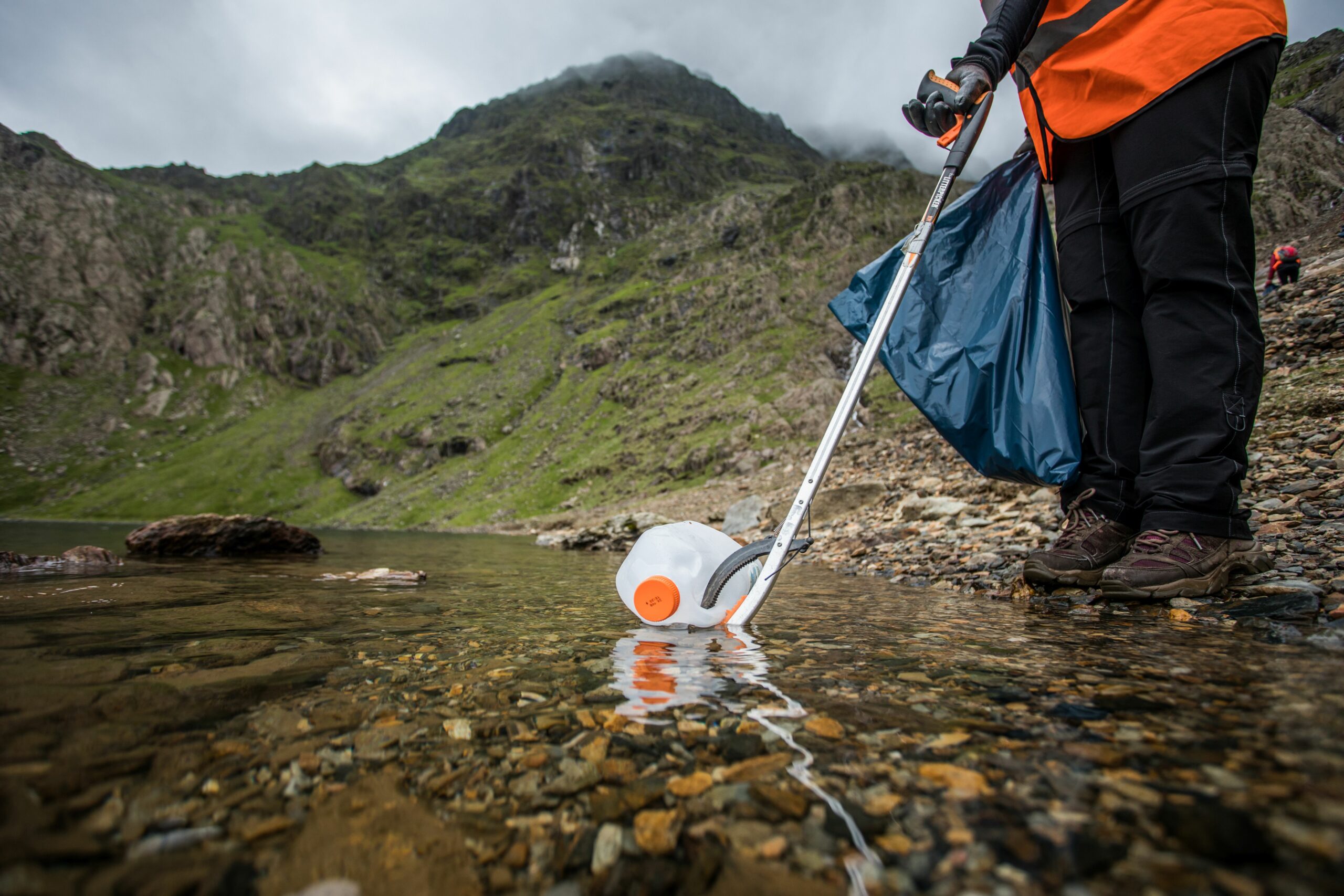
Unfortunately this remains a big problem and it is essential that no litter, clothing or redundant equipment are left behind anywhere in the countryside or mountains. Carry all litter or food/ drink wrappings and containers away including bio- degradables such as food waste, banana skins, orange peel, apple cores and tea bags. These can take years to degrade and can be unsightly on the mountains and can have detrimental effects on our soils and ecology.
Ensure that the litter/waste problem is part of your pre event discussions briefings with participants prior to setting off and ensure that everything is brought down. Preferably, take it all away with you and recycle as much as possible and please do not deposit waste in local bins. Appoint someone to take charge of this issue as a part of your pre event planning. Be responsible!
Way marking
- They should all be removed promptly following your event (as part of your post event clear up). Any temporary way markers should have the event contact details clearly on the back to enable us to contact organisers for any reason or return those that are left behind by accident. Even on Public Rights of Way, permission will be required from landowners for the erection of any temporary signage or structures such as tents or marquees. Do not attempt to to nail signage to trees.
- Spray marking of any routes is not allowed under any circumstances. If you are uncertain about this aspect, please contact the relevant officers at Eryri National Park Authority.
- Once the event is completed as part of your post event clear up. Kindly note that National Park Car parks are not allowed to be used as checkpoints/refreshments or start/finish points at any time. Remember that these are public places.
- Even small events should consider this aspect – larger events should also have Employers Liability to cover their temporary staff (i.e. marshals, First Aiders or other volunteers). Most insurance companies will give quotations for short events at reasonable costs. Organisers have a legal responsibility for their participants, volunteers or paid staff.
- This can annoy and spoil the enjoyment of other walkers and visitors – especially if this happens frequently during any given Therefore, fundraisers should try to ensure that funds are raised in advance of your event rather than be collected on the day.
Use of Drones
The CAA (Civil Aviation Authority) has set out legal responsibilities that must be adhered to by all users.
There are two type of IDs you may need before flying a drones or model aircraft outdoors in the UK: A flyer ID shows you have passed the basic flying test. An operator ID, which must be labelled on your drone or model aircraft (this is the person responsible for managing a drone or model aircraft).
The following table states the categories at which a Flyer ID and/or Operator ID is required.
| Flyer ID | Operator ID | |
| Below 100g | ✗ | ✗ |
| 100g-249g no camera | ✓ | ✗ |
| 100g or above with camera | ✓ | ✓ |
| 250g or above | ✓ | ✓ |
Basic rules for using drones in Eryri National Park
Even small drones and model aircraft could injure people if you don’t fly them safely.
- This includes people in buildings and transport, including cars, lorries, trains, and boats.
- The rule on minimum distances is different for people involved in what you’re doing: You can fly closer than 50m to people who are with you and who are involved in what you’re doing, such as friends, family or colleagues out flying with you.
- The rules on minimum distances to people are different for drones and model aircraft below 250g. If you are flying a drone or model aircraft that’s below 250g, you can fly closer to people than 50m and you can fly over
- A crowd is any group of people who cannot move away quickly because of the number of other people around them.
- They may panic and fall off cliffs, and you could be held liable.
- Such activities fall under other legislation and may result in prosecution.
- Do not to `buzz` the summit area.
- If you see them, ground your drone immediately to prevent serious injury and potential liability.
- For further advice please contact Natural Resources Wales / Apply to use land we manage and follow any restrictions that apply.
For further information please visit
Supporters Plan & Supply stations
Many event participants are accompanied by spectators, supporters and helpers.
It is crucial that those supporters and helpers do not contribute to any additional traffic congestion whilst following an event or by inadvertently causing additional parking or congestion issues on public roads, private entrances, public or private car parks and lay-bys.
One of the principle messages of the National Park’s event management guidance is that organisers should include this issue as part of any documentation that is supplied to participants once they are registered for any given event to ensure that those messages are clear to all well before the event takes place.
Checking in, food and refreshment stations should also be placed where no disruption will occur. Support vehicle/s parking should be minimal and all paraphernalia removed as quickly as possible after the event, Please note that use of local bins is not permitted, all litter accumulated as part of the event should be removed by the events team and disposed of correctly.
Kindly note that the National Park will charge a fee for the use of any of its car parks and organisers must consult with NP Officers well in advance of any planned event to obtain that consent.
Open fires
Open fires (including barbeques) are not allowed.
For further information please visit
Open Fires
Therefore, if you can see any stock then always put your dog on a lead. See link below:
Wild Camping Advice
Wild camping is not allowed within the National Park under current legislation and permission is required from relevant landowners.
There is also a limited number of mountain bothys within the National Park and further information can be obtained from the Bothys Association website link below:
After your event!
Post event clear ups are essential and all litter, paraphernalia i.e. flags, signs, banners or other items should be removed on the same day and nothing should be left once your event is completed. There are no facilities for rubbish or litter disposal anywhere in the uplands so what goes up must come down and pre arrange to take it home or dispose of it suitably. Nothing should be left at any National Park car parks including Pen Y Pass.
Please do not use local bins for disposal of waste/litter following your event. This places an undue burden on local resources so plan to take it all away. Provision should also be made to make sure that no organic food waste or litter is left anywhere on the mountain(s) including peel, banana skins, tea bags or any other food waste is brought down. We recommend that you could include this information in your participants briefing/induction packs well before your arrival so everyone knows their responsibility to keep our mountains, our countryside and ecosystems in pristine condition for all to enjoy.
Once completed it is good practice and a useful exercise to discuss with your participants, the National Park and relevant landowners the event and to gain their views and get some feedback generally. There may be issues that may not have been apparent to you as organisers.
Other fundraising event advice in the UK
There is also generic guidance for Outdoor Fundraising Events in the UK produced jointly by the Institute of Fundraising and National Parks UK. This was prompted by particular concerns about insensitive or poorly organised activities within designated areas. Its aim is to reduce those potential problems by encouraging organisers to work in conjunction with the National Park Authorities, land managers, other relevant organisations and local authorities to ensure best practice in terms of the environment and safety.
See link below to the Guidance for Outdoor Fundraising Events including the Three Peaks Partnership advice. Please read and follow these codes.